
ERC-8004 Trustless Agents: The Complete Guide to Blockchain Trust Infrastructure for AI and Web3 Applications
 17 Nov 2025
What is ERC-8004 Trustless Agents?
ERC-8004 Trustless Agents is a draft Ethereum Improvement Proposal (EIP), created on 13 August 2025, that seeks to build a decentralized trust and reputation layer for autonomous agents, AI services and Web3 applications. It defines standardized on‑chain registries for agent identity, feedback‑based reputation, and third‑party validation, enabling agents to be discovered and assessed without relying on centralized intermediaries. The proposal focuses on identity, reputation and validation mechanisms, while leaving payments and economic incentives to complementary protocols.
Quick Definition:
ERC-8004 is a blockchain standard that enables AI agents, smart contracts, and decentralized applications (DApps) to build verifiable reputation and trust scores on-chain, similar to how ERC-20 standardized tokens and ERC-721 standardized NFTs.
Core Purpose
The standard solves the critical “trust problem” in decentralized systems by providing:
- Decentralized identity management for agents and users
- On-chain reputation tracking that’s transparent and portable
- Third-party validation mechanisms for agent work quality
- Spam prevention through economic incentives
How Does ERC-8004 Work?
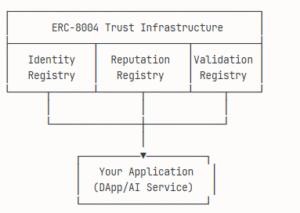
ERC-8004 operates through three interconnected smart contracts that form a trust infrastructure layer:
ERC-8004 Architecture Overview:
The Trust Flow Process
- Agent Registration: A developer registers an agent by minting an ERC‑721 token in the Identity Registry. The token holds the agent’s domain and address and automatically assigns a unique AgentID; it also resolves to an off‑chain “agent card” describing the agent.
- Identity Assignment: Each agent’s identifier combines the blockchain’s chain ID, the identity registry address and a sequential token ID, creating a globally unique namespace for autonomous agents
- Interaction Recording: When clients submit feedback or validators post verification results, the contracts emit on‑chain events (e.g.,
NewFeedback) and store compact data such as scores and tags. Detailed logs can be stored off‑chain and referenced by URIs whose hashes are anchored on‑chain. - Reputation Building: Clients can rate an agent’s performance using a score between 0 and 100, with optional tags for context. Independent validators may also submit verification responses for tasks. These signals accumulate over time, and external services can aggregate them into a reputation profile.
- Trust Verification: Other agents or users can query the registries for an agent’s identity and summary statistics (such as the number of ratings and average score) via functions like
getSummaryandreadFeedback.This allows counterparties to assess an agent’s trustworthiness before interacting.
Key Components of ERC-8004
1. Identity Registry Contract
The Identity Registry serves as the central database for all registered agents:
- Manages unique agent identifiers (Agent IDs)
- Links blockchain addresses to agent domains
- Prevents duplicate registrations
- Maintains registration timestamps
2. Reputation Registry Contract
The Reputation Registry handles feedback and reputation mechanics:
- Authorizes feedback between interacting parties
- Stores feedback permissions on-chain
- Enables reputation portability across platforms
- Provides query mechanisms for reputation data
3. Validation Registry Contract
The Validation Registry facilitates third-party verification:
- Manages validation requests and responses
- Implements time-bounded validation periods
- Stores validation scores (0-100 scale)
- Prevents double validation attempts
Benefits and Use Cases
Key Benefits
For Developers and Platforms:
- Plug-and-play trust infrastructure
- Reduced verification overhead
- Network effects from shared reputation
- Standardized integration interfaces
For Users:
- Portable digital identity across platforms
- Transparent agent/service provider history
- Protection from scams and bad actors
- Informed decision-making based on reputation
For AI Agents and Service Providers:
- Build reputation once, use everywhere
- Fair competition based on merit
- Direct user relationships without intermediaries
- Permanent, verifiable credentials
Real-World Use Cases
NFT Marketplaces and Digital Art Platforms
- Verify authentic artists vs. copycats
- Track creator reputation across sales
- Enable buyer/seller feedback systems
- Validate artwork originality through third parties
DeFi (Decentralized Finance) Applications
- Assess trading bot performance history
- Verify smart contract auditor credentials
- Track lending protocol reliability
- Build credit scores for undercollateralized loans
AI Agent Marketplaces
- Rate content generation quality
- Track translation accuracy scores
- Verify code generation reliability
- Assess data analysis performance
Gaming and Metaverse Platforms
- Cross-game player reputation
- Item trader authenticity verification
- Guild management credentials
- Tournament organizer trust scores
Decentralized Social Networks
- Content creator verification
- Moderator reputation tracking
- Influencer authenticity scores
- Community leader credentials
ERC-8004 vs Other Standards
ERC-8004 vs Traditional Web2 Systems
- Decentralized vs. Centralized control
- Portable vs. Platform-locked reputation
- Transparent vs. Opaque algorithms
- Immutable vs. Editable records
ERC-8004 vs Other Blockchain Standards
- ERC-20: Tokens vs. Trust infrastructure
- ERC-721: NFT ownership vs. Agent reputation
- ERC-1155: Multi-tokens vs. Identity system
- DID (Decentralized Identifiers): Identity only vs. Identity + Reputation + Validation
Implementation Guide
Prerequisites for Implementation
- Understanding of Ethereum smart contracts
- Familiarity with Web3 development
- Access to Ethereum nodes (mainnet or testnet)
- Smart contract deployment capabilities
Implementation Phases
Phase 1: Infrastructure Setup
- Deploy or connect to existing ERC-8004 registries
- Configure contract addresses and interfaces
- Set up event listeners for registry updates
Phase 2: Platform Integration
- Update smart contracts to interact with registries
- Design user flows for agent registration
- Implement reputation display mechanisms
Phase 3: User Adoption
- Create incentives for agent registration
- Educate users about reputation benefits
- Launch with early adopter programs
Phase 4: Optimization
- Implement gas-efficient patterns
- Add caching layers for frequent queries
- Develop reputation aggregation tools
Phase 5: Advanced Features
- Multi-validator consensus mechanisms
- Cross-chain reputation bridges
- AI-powered reputation analysis
Challenges and Solutions
Current Challenges
Technical Challenges:
- High gas costs on Ethereum mainnet
- Scalability limitations for high-frequency updates
- Cross-chain interoperability complexity
- Smart contract upgrade difficulties
Adoption Challenges:
- Network effects require critical mass
- User education about benefits
- Integration complexity for developers
- Competition with centralized alternatives
Proposed Solutions
For Gas Costs:
- Layer 2 deployment (Polygon, Arbitrum, Optimism, Base)
- Batch transaction processing
- Off-chain computation with on-chain verification
For Scalability:
- Hybrid on-chain/off-chain architecture
- IPFS for metadata storage
- Event-based indexing systems
For Adoption:
- Developer grants and incentives
- Partnership with major protocols
- Open-source tooling and SDKs
- Educational content and tutorials
Future of ERC-8004
Current Status
As of November 2025, ERC-8004 has been proposed and has a reference implementation available on GitHub. The actual adoption timeline will depend on:
- Community feedback and iterations
- Developer adoption rate
- Integration by major protocols
- Market demand for decentralized trust infrastructure
Potential Development Areas
Rather than a specific timeline, these are areas where ERC-8004 could evolve:
- Layer 2 deployments for gas efficiency
- Cross-chain compatibility improvements
- Integration with existing DeFi and NFT protocols
- Development of reputation aggregation standards
- Enhanced validation mechanisms
Community-Driven Evolution
The future of ERC-8004 will be determined by:
- Developer community contributions
- Real-world implementation feedback
- Governance decisions by adopting protocols
- Market needs and use case evolution
Frequently Asked Questions (FAQs)
General Questions
Q: What is ERC-8004 and why is it important? A: ERC-8004 is a blockchain standard that creates a decentralized trust and reputation system for AI agents and Web3 applications. It’s important because it solves the trust problem in decentralized systems without requiring centralized authorities.
Q: How is ERC-8004 different from ERC-20 or ERC-721? A: While ERC-20 defines fungible tokens and ERC-721 defines NFTs, ERC-8004 defines a trust infrastructure with identity, reputation, and validation systems specifically designed for agents and service providers.
Q: Who created ERC-8004? A: ERC-8004 was developed by the Ethereum community with significant contributions from the A2A Protocol team and ChaosChain developers, building on the need for trustless agent interactions.
Technical Questions
Q: What blockchain networks support ERC-8004? A: ERC-8004 is compatible with Ethereum and all EVM-compatible chains including Polygon, BSC, Arbitrum, Optimism, Base, and Avalanche.
Q: How much does it cost to register as an agent? A: Registration requires 0.005 ETH as a spam prevention fee, which is burned (destroyed) rather than collected by anyone. Additional gas fees apply based on network conditions.
Q: Can ERC-8004 work with artificial intelligence and machine learning systems? A: Yes, ERC-8004 is specifically designed to support AI agents, ML models, and automated systems by providing them with persistent identity and reputation mechanisms.
Q: Is ERC-8004 compatible with ChatGPT, Claude, or other AI assistants? A: While AI assistants like ChatGPT and Claude don’t directly interact with blockchains, ERC-8004 can be used by blockchain-based AI agents that might interface with these systems through APIs or oracles.
Implementation Questions
Q: How do I implement ERC-8004 in my project? A: Implementation involves deploying or connecting to the three registry contracts (Identity, Reputation, Validation), integrating them with your smart contracts, and implementing user interfaces for registration and reputation display.
Q: Can I use ERC-8004 for my NFT marketplace? A: Yes, ERC-8004 is ideal for NFT marketplaces to verify creators, track seller reputation, and enable buyer feedback systems.
Q: Do users need to pay for every interaction? A: Users only pay for registration (0.005 ETH) and gas fees for transactions. Reading reputation data is free.
Security and Trust Questions
Q: How does ERC-8004 prevent fake reputation? A: The system uses economic incentives (registration fees), on-chain transparency, and third-party validation to make fake reputation expensive and detectable.
Q: Can reputation be transferred between accounts? A: No, reputation is tied to specific Agent IDs and cannot be transferred, preventing reputation trading or theft.
Q: What happens if someone gives false feedback? A: While the protocol doesn’t prevent false feedback, the transparent nature allows community monitoring and future versions may include dispute resolution mechanisms.
Business Questions
Q: Is ERC-8004 suitable for enterprise use? A: Yes, enterprises can use ERC-8004 for supply chain verification, B2B reputation systems, and automated agent interactions.
Q: What are the main advantages over traditional reputation systems? A: Decentralization, portability across platforms, transparency, immutability, and no single point of control or failure.
Q: How can ERC-8004 benefit my Web3 startup? A: It provides instant trust infrastructure, reduces development time, enables network effects through shared reputation, and increases user confidence in your platform.
Resources and Further Reading
- Official ERC-8004 Specification: EIP-8004 on Ethereum.org
- GitHub Repository: Reference Implementation
- A2A Protocol: Foundation Website
- Developer Documentation: Available on GitHub
- Community Discord: Join discussions with implementers
- Technical Support: Stack Overflow tag:
erc-8004
Conclusion
ERC-8004 Trustless Agents represents a paradigm shift in how we establish trust in decentralized systems. By providing a standardized, transparent, and portable reputation system, it enables the next generation of AI agents, Web3 applications, and decentralized services to operate with confidence and accountability.
As blockchain technology and AI continue to converge, standards like ERC-8004 become essential infrastructure for the decentralized future. Whether you’re building an NFT marketplace, DeFi protocol, or AI agent platform, ERC-8004 offers the trust layer needed for sustainable growth and user adoption.
If you’re looking for an agentic blockchain-powered solution, feel free to reach out to us at info@wnexus.io
